
In 2020, I made a prediction that many thought was too bold: within five years, the smartphone would start to feel obsolete. Not because it would vanish overnight, but because another technology would begin to replace the brick we carry in our hands, pockets, and purses just to interact with the digital world.
I tried to anticipate what it might look like. Some of my ideas included glasses that project screens onto surfaces, personal keys that unlock hidden content, and, on the other side of the equation, new ways to input information: through haptics, through voice, or through predictive systems that finish your thoughts before you do.
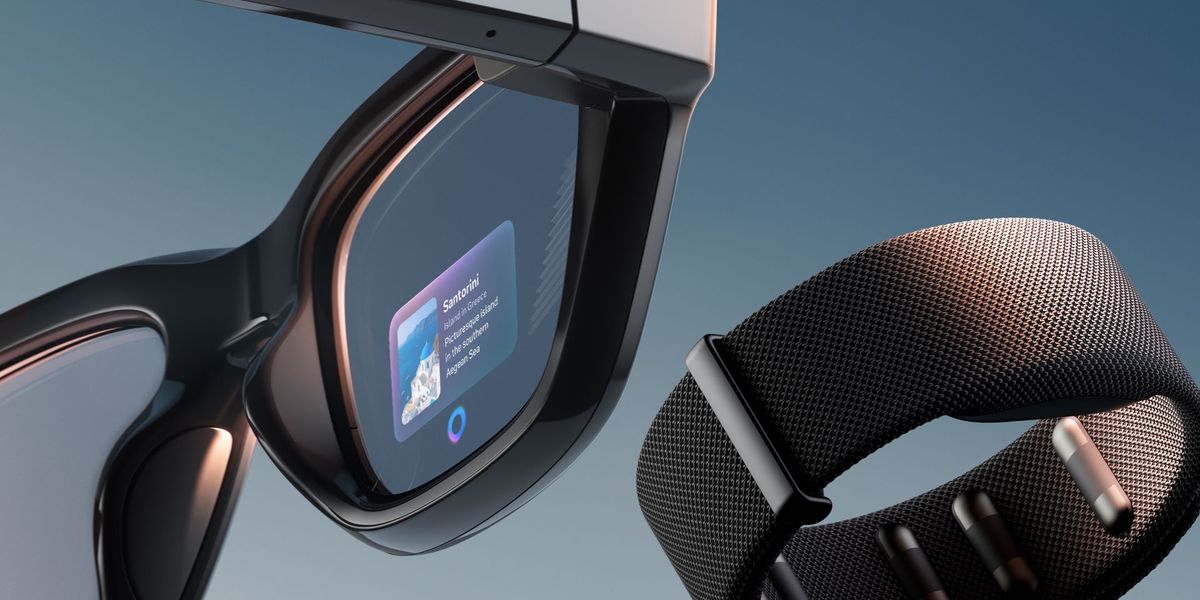
The truth is, the five years came and went without that full replacement. Smartphones are still with us. But exactly five years later, we are seeing clear signs that the prediction is on the right path. Last week, Meta unveiled a technology that, for the first time, feels like the full package. Their new AI glasses with a built-in display, combined with a wristband for input, show a patient and deliberate approach to shifting us beyond the phone.
The wristband is subtle but powerful. It picks up faint electrical signals from your muscles and translates them into text or commands. That means you can “type” by moving your fingers in the air or even on your leg, quietly and privately. Imagine answering a message on the subway without pulling anything out of your pocket. Because your fingers become the keyboard, the system goes wherever you go. It isn’t full neural input yet, but it is the natural step toward it, preserving privacy while easing people into a new form of interaction.
On the display side, Meta also resisted the temptation to jump too far ahead. They didn’t go all-in on a bulky VR headset or try to overlay full augmented reality onto the world. Instead, they built a compact, glanceable heads-up display that surfaces just what you need: a message, a translation, a photo, a quick query to Meta AI. It may not sound like much, but this patient step matters. History rewards the teams that build the useful bridge, not the perfect fantasy. With these glasses, you don’t fish out your phone for the basics. The screen comes to you.
Yes, the demo had hiccups. Live tech demos are cursed. But the real achievement isn’t the stage show, it’s the way Meta managed to keep the human element intact. These glasses don’t demand you disappear into a headset. The wristband doesn’t force you to speak out loud. Together, they create a way to interact with technology that protects privacy, respects presence, and blends into daily life instead of overwhelming it. That’s why this feels credible: not because it’s flashy, but because it’s humane.
This shift is not only fascinating for technologists. It will be a shock to an entire generation that grew up with the smartphone as the center of their identity and social life. Young people today are the first “phone-native” generation. Their earliest memories, friendships, and even
schoolwork have been filtered through a screen in their hand. For them, the phone is not just a tool; it is a mirror of self. To imagine life without it is almost like asking them to picture a world without electricity. And yet, they too will adapt. Just as older generations once had to learn to text, the younger ones will be asked to rethink what connection feels like when it’s no longer tied to holding a device.
This brings me to a word I’ve started using to describe this new class of technologies: the interactor.The interactor is the layer where humans and machines meet, the input and the output, together. For decades, the smartphone has been the dominant interactor. We tap, swipe, type, and stare into its glass. But that dominance is ending. The race is now about finding the best interactor for the next era.
History gives us the rhythm: hardware, then software, then hardware again. First came the personal computer, a hardware revolution. Then the internet became a connectivity software revolution. Then smartphones, another hardware leap. Then AI, a software boom that has reshaped industries in just a few years. Now it is hardware’s turn again. Our phones already feel outdated, not because they stopped working, but because they cannot keep up with the new possibilities AI has unlocked.
This cycle also explains why adoption takes time. Software spreads fast, Zoom became a global infrastructure in months, generative AI entered workplaces in less than two years. Hardware moves slower, because it requires manufacturing, new habits, and cultural acceptance. But once the use case is clear, hardware catches up. Right now, the software is already waiting for better containers, and devices like Meta’s are starting to provide them.
Markets will, of course, keep demanding perfection. But the smarter path is patience. People need time to adjust to new interaction models. Once habits shift, though, there is no going back. My bet is that this change will happen faster than most expect. The smartphone isn’t disappearing, it’s being absorbed into lighter, more ambient devices that live on your face and your wrist.
Show a photo of any street today to someone from the 1980s and it looks absurd: crowds of people staring at glowing rectangles. Soon, photos of us flicking our fingers and glancing ahead will look just as ordinary. That is the true marker of a paradigm shift, when something strange becomes invisible.
The only question left is a personal one: when do you buy the device that makes your phone optional? Somewhere out there, someone is already holding the last phone they’ll ever buy. And they don’t even know it yet.