
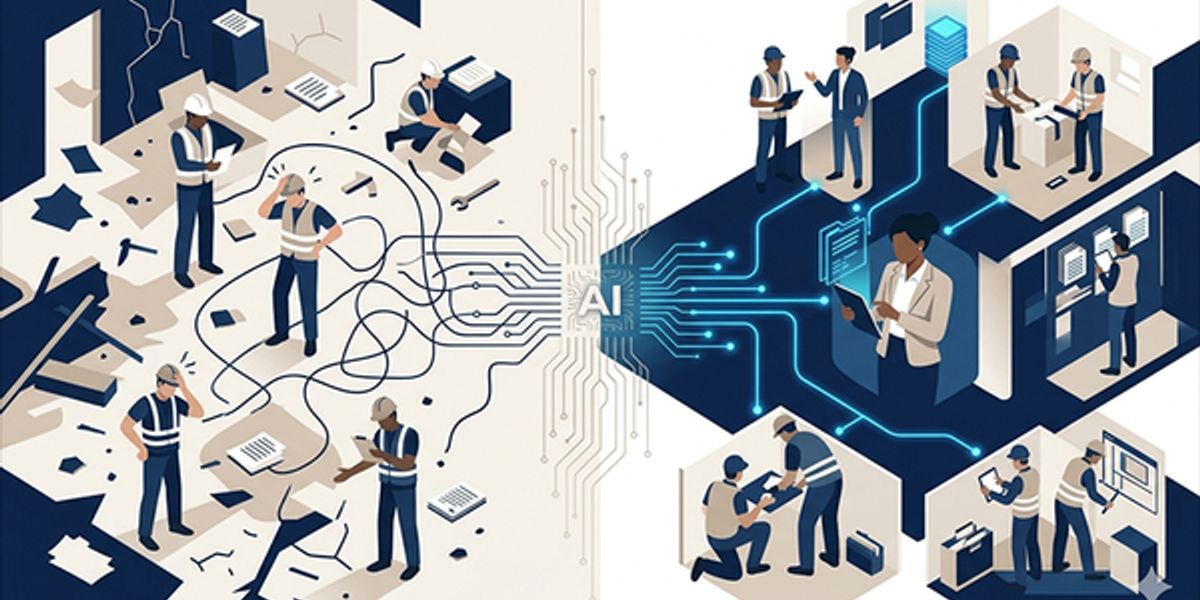
Most companies spend months, and some even years preparing for AI. They research different tools, plan all kinds of rollouts, and build excitement inside. The day they start using AI feels like a massive milestone. And then the real work begins.
What happens right after implementation is something very few companies talk about. But that is exactly where everything is decided.
Workflows Start to Change
The first thing people notice is speed and that means tasks that used to take hours now take a couple minutes. Reports that required three people working on them, can be drafted by one. Steps in processes start to disappear. This sounds entirely positive, and at first sight, it is really.
But a small change in one part of a workflow, then affects every other part. When one team moves faster, the teams around them have to adjust to the new speed. New bottlenecks appear in many different places no one expected to. The process is far different from how it was firstly designed on paper.
This is just what real change actually looks like.
Roles and Responsibilities Shift
People start doing a lot of different things. Repetitive tasks slowly shrink and they have a lot more time for thinking and deciding.
Some people inside the teams move and adapt quickly. They find their work more interesting, they move faster and even feel more effective.
Others find this shift a lot harder. Their confidence previously was built around the tasks that AI now handles. They are not sure where and how they fit anymore.
Both reactions will appear at the same time and both of them are completely normal. Change always lands differently for different people.
Decision Making Speeds Up
One of the biggest changes after AI implementation is how decisions get made. Suddenly more data is available and answers come a lot faster. Waiting time is reduced significantly.
Speed alone does not always mean better decisions than before. If the questions being asked are wrong, faster answers just give wrong directions. Yes, AI gives you more power and ability, but judgement is still in the hands of humans.
Resistance Appears
This part is rarely talked about. But it happens inside every company.
Not everyone trusts the new system, the new workflow. Some people are right there, but are quietly going back to their old ways, where they feel safe. Others often double check every answer they get from an AI tool before acting on it. There would be even some of them that totally ignore the results and rely on their own instinct.
People always trust what they already understand. If AI was introduced without clear direction,and explanation, then resistance is a really reasonable response. The tech may be right, but it means the transition from the old ways was not fully supported.
The Gap Between Technology and Adoption
This is exactly where most companies get stuck.
The AI is here and is running, and the team is not fully using it. Results somehow feel partial, leaders grow really frustrated because ROI does not match the expectation.
The gap is real.
It is only about how AI adoption was introduced. Who was included in the process and how workflows were redesigned. How people were supported through the change.
When these things are missing, it is always expected that even the best AI system would underperform.
What Successful Companies Do Differently
Companies that get real results from AI effectively guide their teams through the change. They redesign workflows to fit how AI actually works. They often check in, make changes and adjust, and in the process make sure that people and systems are genuinely aligned.
They treat AI implementation as the beginning of a process, and not the end of a project.
How Wave Group Approaches This
Wave Group does not just implement AI and hand over the keys.
We stay involved in what happens after. We help teams understand the system they are working with. We look at how workflows are actually changing on the ground. We identify where the gaps are between technology and real adoption.
The goal is not just for AI to be present in your business. The goal is for your business to actually work differently because of it. That is what digital transformation means in practice.
The Real Work Starts After
AI implementation is only the starting point.
What happens in the weeks and months after determines whether the investment pays off. It determines whether your team grows with the technology.
If your team is not fully using AI, the problem is not the technology. It is what happened after it was introduced. And that is exactly where the right partner makes all the difference.