

Part 1: Strategic Mapping of the InsurTech Landscape
In the past months, InsurTech has emerged as one of the most dynamic sectors of digital transformation. Similar to the FinTech wave, its ecosystem is evolving rapidly, yet maturity, in terms of exits and unicorn-level valuations, remains in early stages. This presents both a challenge and a profound opportunity. Wave Group undertook a strategic dissection of the vertical to identify core areas of enterprise value creation. The outcome is a practical framework not just for venture investors but for digital transformation leaders within incumbent insurance organizations.
Step 1: Mapping the Ecosystem by Customer Type
We first distinguished between two primary customer types for InsurTech platforms:
-
B2C (End-users): Policyholders – either individuals or businesses.
-
B2B (Enablers): Insurance companies, brokers, and carriers – entities focused on operational optimization and risk performance.
Each customer group has distinct levers of value. Understanding and addressing them through targeted technological solutions is the foundation for sustainable competitive advantage.
Step 1 (Option 1): B2C – Capturing Value Through Experience Unification
Insurance remains one of the least satisfying consumer experiences. B2C startups that can unify fragmented interactions – from product comparison and purchase to claims and reimbursement – stand to capture outsized market value.
Key Insight: The most impactful models are not isolated tools, but platforms that integrate and own the customer journey, from onboarding to payouts.
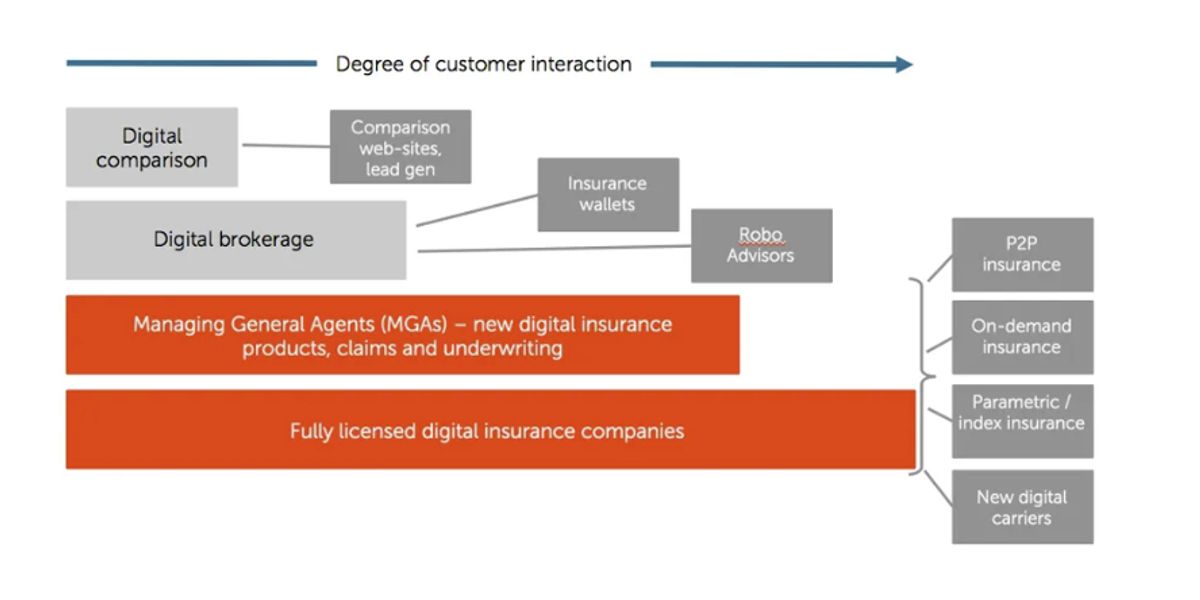
Step 1 (Option 2): B2B – Reducing Combined Ratio as Core Value Driver
Insurers measure performance using a critical KPI: the Combined Ratio (CR) – the ratio of claims and operational costs to premiums earned. For B2B-focused InsurTech ventures, the imperative is clear: improve this ratio.
Wave Group identified two transformative technologies with broad application across both B2B and B2C segments:
-
IoT: Enables proactive risk mitigation, behavioral underwriting, and real-time incident tracking.
-
Blockchain: Offers potential in automating claims workflows, reducing fraud, and verifying asset ownership.
Where does enterprise value emerge?
-
For B2C, it is about owning the interface and experience – blending seamless digital touchpoints with risk-bearing or risk-sharing products.
-
For B2B, it is about moving the Combined Ratio – delivering measurable cost and risk improvements to incumbents.
Recommended steps to take:
Focus investment and transformation efforts on platforms and tools that sit at these value intersections – especially MGAs with tech-first DNA, claims automation, and AI-enhanced underwriting.
Part 2: Scaling Based on Sub-Category Growth
Step 2: Which Activities Can Be Turned Into Highly Valuable Technology-Based Business Models?
Now that we have determined the sub-categories that allow for high value creation in InsurTech, the last step is to determine those sub-categories that will allow tech startups to build large businesses and create massive (enterprise) value. The following are prerequisites:
-
Scalability: Does the sub-category face a problem or inefficiency that is repeatable for a large number of cases? This could be a scalable distribution to large customer groups or standardized processes across different countries and areas.
-
Defensibility: How resilient is the company to relying on the technology, and how to secure growth and value as economies scale? Learning-based service improvement is the most common answer to this problem.
-
Customer Inertia: Startups must overcome lock-in effects of long-term contracts and slow-moving incumbents. Lower inertia in P&C than in life/health insurance is key.
-
B2C – Unified Experience: The broader the customer journey is covered and improved, the higher the potential value.
-
B2B – CR Impact: Addressing claims costs (~70%) has more impact than operating costs (~20%) in CR improvements.
Step 3: Product for locking in value
- On-Demand Insurance
Provides coverage only when needed, reducing costs and increasing flexibility. It supports high automation, data-driven improvement, and is extensible to many product lines. Lock-in occurs through accumulated behavioral data and predictive pricing models.
- Peer-to-Peer Insurance
Establishes new, self-regulating risk pools where group behavior lowers costs and claims. Strong lock-in through positive selection and community effects. High CR impact, especially in standardized, low-inertia P&C policies.
- New Digital Insurance Carriers
Owning the full customer journey allows innovation, but high licensing barriers ensure defensibility. However, switching costs and inertia in health/life policies can slow growth. Works best where contract cycles are short and customer acquisition is efficient.
- Loss Prevention
IoT devices and pre-policy interventions can drastically reduce claim volumes. Scalable across homes, vehicles, and businesses. Requires minimal integration and is easy to pilot. Rapid value generation potential.
- Fraud Prevention
Leverages behavioral analytics and AI to detect false claims. Valuable due to direct impact on claims ratio and increasing performance over time via machine learning. High lock-in potential.
- Claims Management Efficiency
Focuses on the 25% of operating costs attributed to claims processing. While a smaller component, the high frequency and repetitive nature make it ripe for automation. Several InsurTechs already show significant savings here.
- Risk Modeling and Predictive Underwriting
Harnessing new data sources and real-time behavior enables more precise underwriting. This improves product margins and pricing elasticity. Image recognition, mobile data, and vehicle telematics are core enablers.
Summary
Across this three-step analysis, we mapped the insurance industry through the lens of customer type, value creation, and scalability. Unlike static market maps, this framework reveals where enterprise value is likely to emerge and why. The result is a hypothesis-led overview of InsurTech models with scalable, defensible, and high-impact potential. This is not a definitive list nor a ranking, but a directional guide for strategic investment and transformation. The insurance industry remains vast, under-digitized, and primed for disruption.