
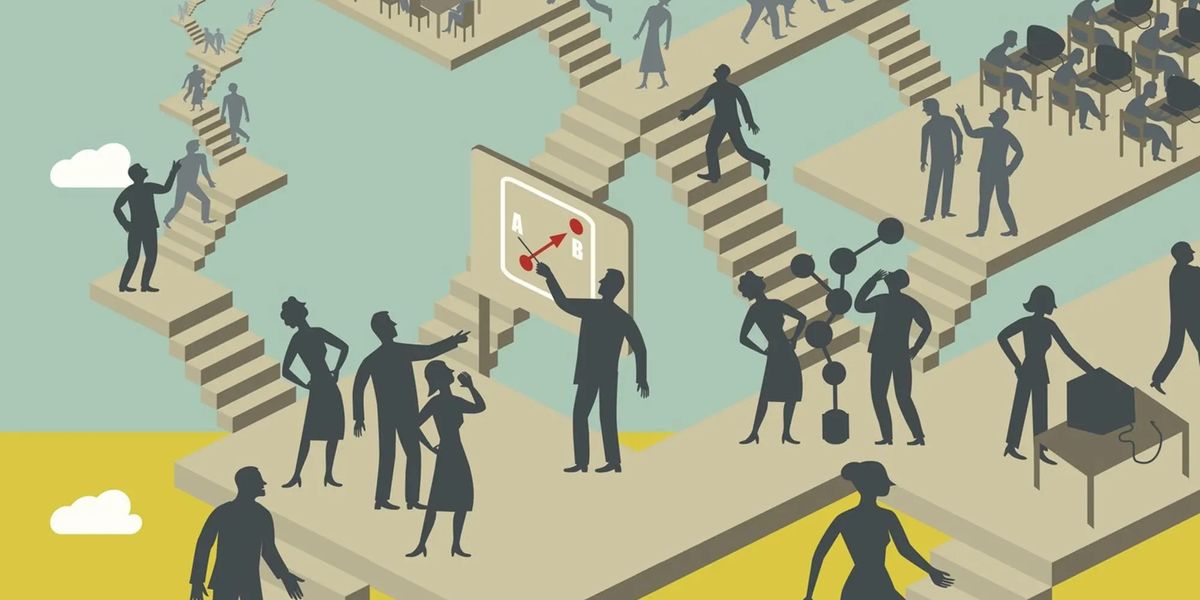
Ask someone how their company is organized and they will almost always describe departments. Sales. Marketing. Finance. Operations. Customer Support. Everyone has clear responsibilities. Everyone works hard within their area.
And yet many of those same businesses experience the same persistent problems. Information gets lost between teams. Projects slow down every time work moves from one department to another. Customers repeat themselves because nobody seems to have the full picture.
The problem is rarely the people. It is that the business was designed around departments instead of connected systems.
Departments naturally create boundaries
Every department tends to optimize for its own goals. Sales wants more leads. Marketing wants better campaigns. Operations wants efficiency. Finance wants control over costs. These are all reasonable objectives and none of them are wrong.
But when every department optimizes independently, the business can become quietly disconnected. One team improves its numbers while creating friction for another. Customers experience delays at the handoffs between teams. Employees spend significant time on coordination that exists only because information does not flow naturally from one part of the business to the next.
The whole becomes less than the sum of its parts. Not because any individual part is weak, but because the parts were never designed to work together as one thing.
System thinking focuses on how work actually moves
The shift from department thinking to system thinking is a change in what leaders pay attention to.
Department thinking asks how each team can perform better within its own boundaries. System thinking asks how work, information, and decisions flow across the entire organization. Where do handoffs slow things down? Where does information get recreated by a second team because the first team's data never reached them automatically? Where do customers experience the gap between how departments see themselves and how the business actually serves them?
When customer information flows automatically between teams, nobody has to ask for an update. When AI prepares the right information before people need it, decisions happen faster and with more confidence. When systems communicate with each other directly, employees stop spending their time copying information from one place to another and start spending it on work that actually requires their judgment.
The business stops feeling like a collection of separate teams and starts operating as one connected thing.
Why AI makes this more important, not less
AI creates significantly more value inside connected organizations than inside fragmented ones. When information is scattered across isolated systems and separate departments, AI can only see part of the picture. The insights it provides are limited by the gaps in what it can access.
When systems are connected and information flows freely across the organization, AI can provide better recommendations, identify patterns that span multiple teams, and automate workflows across the entire business rather than just within a single department.
AI does not remove silos on its own. Organizations have to redesign how information flows before AI can deliver its full value. The technology follows the design. It does not replace the need for one.
Why this becomes a competitive advantage
Businesses designed around connected systems respond faster to change because information reaches decision makers without delays. They adapt more easily because improvements to one part of the system benefit the whole rather than staying contained within a single team. They make better decisions because the data supporting those decisions is complete rather than partial.
They scale with less friction because growth does not automatically require adding more coordination overhead. And they deliver better customer experiences because the customer journey is designed as one continuous flow rather than a series of handoffs between departments that do not fully see each other.
About Wave Group
Wave Group helps organizations move beyond disconnected departments by designing connected business systems powered by AI, automation, blockchain where appropriate, and modern digital infrastructure. The focus is not simply implementing technology. It is creating organizations where information flows naturally, decisions happen at the right speed, and every part of the business works toward the same outcome. Because the strongest businesses are not collections of great departments. They are connected systems that perform as one.
For years, businesses measured success by the strength of individual teams.
The next generation of successful companies will be measured by how well those teams work together.
The companies that continue thinking in departments may keep improving individual performance. The companies that start thinking in systems will improve the entire business. Over time, that difference will become impossible to ignore.